
Campers drawing from silty streams need more than a fine-pore filter: suspended sediment can slow flow and shorten cartridge life. This guide compares 5 options for prefiltration setups, with distinctions among hand pumping, gravity use, powered treatment, and personal straws.
Product descriptions provide specifications, but they do not establish identical performance against every contaminant or water condition. For treatment basics and system selection, see our camping water purifier guide, then check each manufacturer’s instructions before use.
Pros
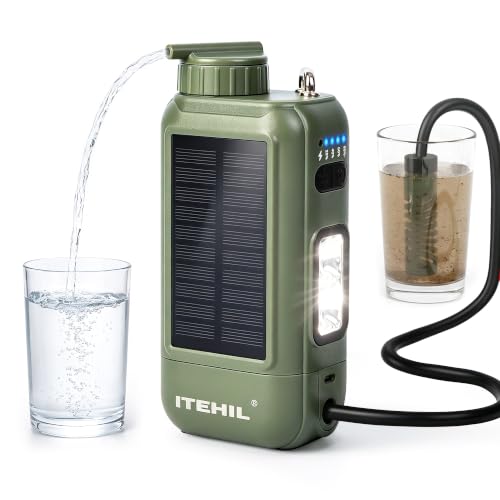
- 0.01-micron filtration precision
- 700 ml-per-minute flow rate
- Solar and USB-C charging
- Integrated emergency light
- 5200mAh rechargeable battery
Cons
- Six-month cartridge replacement guidance
- Replacement timing varies with water quality
- Requires powered operation
Specifications
| Dimensions | 3.2 x 2.4 x 7 inches |
|---|---|
| Weight | 0.0625 Pounds |
| Product Group | BISS |
Verify the current product variation before purchase; specifications may change.
Detailed Review
Key features from the product listing:
- Dual filtration targets bacteria, viruses, parasites, sediment, odors, and turbidity
- 700 ml-per-minute output supports faster campsite water treatment
- 5200mAh battery provides up to four hours of operation
- Solar and USB-C charging support off-grid and outage use
- Integrated light and power-bank functions add emergency utility
- Backpack hook improves portability during hikes and evacuations

Specifications
| Color | Transparent |
|---|---|
| Size | Small |
| Dimensions | 3 x 3 x 6 inches |
| Weight | 0.7 Pounds |
| Product Group | Outdoors |
| Binding | Sports |
Verify the current product variation before purchase; specifications may change.

Specifications
| Dimensions | 10 x 10 x 17 inches |
|---|---|
| Product Group | BISS |
| Binding | Tools & Home Improvement |
Verify the current product variation before purchase; specifications may change.

Pros
- 0.01-micron claimed filtration
- 700 ml-per-minute flow
- 5200mAh rechargeable battery
- Solar charging capability
- Compact 3 x 2.3 x 7-inch body
Cons
- Pathogen and chemical treatment limits need verification
- Solar charging performance depends on sunlight
- Six-month replacement guidance adds maintenance
Specifications
| Dimensions | 3 x 2.3 x 7 inches |
|---|---|
| Product Group | BISS |
Verify the current product variation before purchase; specifications may change.
Detailed Review
Key features from the product listing:
- 700 ml-per-minute flow fills bottles quickly at camp
- 0.01-micron membrane targets microscopic suspended impurities
- 5200mAh battery supports off-grid filtration and phone charging
- Solar charging adds backup power during outages
- Compact pouch-friendly design fits hiking and emergency kits
- Replaceable cartridge rated for up to 1,000 liters
Best For / Avoid If
Best for buyers prioritizing
- 0.01-micron claimed filtration
- 700 ml-per-minute flow
- 5200mAh rechargeable battery
Consider another option if
- Pathogen and chemical treatment limits need verification
- Solar charging performance depends on sunlight
- Six-month replacement guidance adds maintenance

Pros
- Eight-filter pack
- Under 1.8-ounce claimed weight
- Backflushable design
- Bottle and gravity-system compatibility
- 5,000-liter claimed capacity
Cons
- No stated pore-size specification
- Flow depends on source-water quality
- Requires suitable accessories for some setups
Specifications
| Color | orange |
|---|---|
| Size | 8 PCS |
| Dimensions | 8 x 1.2 x 1.2 inches |
| Weight | 0.1 pounds |
| Product Group | Outdoors |
Verify the current product variation before purchase; specifications may change.
Detailed Review
Key features from the product listing:
- Eight filters support multiple kits, vehicles, or group members
- Under 1.8 ounces, it adds little backpack weight
- Manufacturer-rated 800 ml/min flow supports direct drinking
- Backflushable design helps reduce clogging after repeated use
- Compatible with water bottles and suitable accessories
- Compact format fits pockets, packs, and emergency bags
Best For / Avoid If
Best for buyers prioritizing
- Eight-filter pack
- Under 1.8-ounce claimed weight
- Backflushable design
Consider another option if
- No stated pore-size specification
- Flow depends on source-water quality
- Requires suitable accessories for some setups
Separate sediment control from water treatment
Fine sediment can obstruct intake screens and clog filter media, so let visibly muddy water settle before filtering when time allows. Decant clearer water from the top, avoiding settled material, and follow the filter maker’s directions for any permitted prefilter.
A cloth can remove larger debris, but it does not disinfect water or reliably remove pathogens. Do not treat a makeshift sediment screen as a substitute for a listed, compatible filter or other approved treatment step.
Match filtration claims to the hazards
Micron figures describe particle-size claims, not a complete guarantee against every biological or chemical hazard. The Katadyn listing specifies a 0.2-micron glass-fiber cartridge, while ITEHIL and Swonder list 0.01-micron systems; their published descriptions do not provide full, independently verifiable contaminant data.
Uzima’s description states protection against 99.999% of bacteria, and Lormandy describes particle filtration and taste improvement without a stated pore size. Viruses, fuel, pesticides, and dissolved chemicals require particular care: verify the exact claim and use an appropriate additional treatment where needed.
Choose a flow method that suits your group
A hand pump provides controlled collection, but requires repeated effort and time at the source. Katadyn lists a flow rate of one liter per minute; that figure is a stated specification, not a promise for silty water or a dirty cartridge.
Gravity systems can reduce active pumping for a stationary camp, while straws serve individual users rather than group water batches. Compare setup, clean-water storage, and how many liters you need each day, not flow figures alone.
Assess prefilter access and cleaning
Katadyn lists an intake-hose prefilter and a filter protector, useful features when a source carries debris. Its transparent body also makes cartridge condition visible, though visibility does not replace the cleaning and replacement schedule in the manual.
Lormandy says its straws can be backflushed, but the published details do not specify a dedicated sediment prefilter. For silty water, confirm included accessories, compatible cleaning tools, and whether repeated clogging can be managed safely in the field.
Account for power, weight, and repair needs
ITEHIL and Swonder list 5,200 mAh batteries, solar charging, and a 700-milliliter-per-minute rate. Power may help at a base camp, but adds charging dependencies; cloudy conditions and sediment-related slowdowns make solar claims unsuitable as a sole water plan.
Katadyn lists a weight of 11.2 ounces, while Lormandy lists less than 1.8 ounces per straw. Those formats serve different needs: a straw is compact for personal use, whereas a pump or gravity unit may better support shared collection. See our ultralight water filter guide for a separate backpacking comparison.
Compare cartridge life and ownership details
Published lifespan claims vary: Katadyn lists up to 1,150 liters, the electric models list up to 1,000 liters, and Lormandy lists up to 5,000 liters. These figures are not directly comparable because designs, test conditions, water quality, and replacement criteria differ.
Check replacement cartridge availability, storage instructions, backflush limits, and freeze protection before a trip. A filter that cannot be cleaned or replaced when needed may be a poor fit for remote travel, even if its stated capacity appears generous.
Set a budget by actual capability
Entry-level personal straws suit solo emergency kits when the source and treatment claim match the need. Mid-range manual or gravity options make more sense for repeated camp use, while powered units add convenience and extra functions at the cost of battery dependence.
Spending more does not automatically solve sediment, viruses, chemical contamination, or cartridge shortages. Choose the least complex system that covers your source, group volume, and treatment requirements, then carry a compatible backup method.
Why You Should Trust Us
We compare the published product specifications and distinguish listed claims from practical interpretation. We do not treat marketing language, pore size, or stated flow as proof of performance across all water sources.
Where data is missing, including independent contaminant validation, replacement availability, and detailed sediment procedures, we identify that gap rather than fill it with assumptions. Use current manuals and product documentation to confirm suitability before relying on a filter in the field.
Final Thoughts
For a manual setup with an explicitly listed intake prefilter, Katadyn Hiker Pro Transparent Hand Pump Water is the strongest fit in this group. It offers a clear cartridge body and stated one-liter-per-minute rate, but pumping takes effort, and silty conditions can still reduce flow. Pros: intake prefilter, visible cartridge, bottle connections. Cons: manual work and no published claim that it removes viruses. Who should skip it: groups seeking unattended gravity flow or powered dispensing.
As a value-oriented powered option, ITEHIL Portable Electric Water Filter lists solar and USB-C charging, a battery, and a 0.01-micron filtration claim. The added functions may suit car camping, but battery upkeep and limited supplied validation details matter. Pros: powered dispensing and multiple charging methods. Cons: dependence on electronics and unclear independent performance evidence. Who should skip it: backpackers prioritizing a simple, low-maintenance manual system.
For compact personal carry, Lormandy Straw Water Filter 8 Pack provides multiple straws and a stated backflush method, but the published details do not establish a specific pore size or dedicated sediment prefilter. Pros: lightweight individual format and multi-unit pack. Cons: personal-use workflow and limited treatment detail. Who should skip it: family campers needing convenient batch filtration. Browse our water and safety gear category and camping first aid kit guide for broader trip preparation.
FAQs
What is a prefilter for silty water?
A prefilter catches larger sediment before water reaches the main cartridge. Letting mud settle and decanting clearer water can reduce debris, but does not replace pathogen treatment or make contaminated water safe by itself.
Can a camping water filter process muddy water?
Some filters can process turbid water, but sediment may clog intake screens or reduce flow. Follow manufacturer instructions, pre-settle visibly muddy water when practical, and avoid forcing water through a blocked cartridge.
Does a 0.2-micron filter remove viruses?
A micron rating alone does not establish virus removal. Check the exact product documentation for tested organism claims, and use a compatible additional treatment when viral contamination is a concern.
Is a straw filter practical for family camping?
A straw is designed for personal drinking and can be awkward for filling cookware or several bottles. Families generally benefit from a batch-capable pump or gravity system, with a separate backup method.
Are electric camping filters reliable without sunlight?
ITEHIL and Swonder list rechargeable batteries as well as solar charging, but solar input depends on conditions. Keep the unit charged and carry a non-electric backup rather than treating solar charging as guaranteed.
How often should a water filter cartridge be replaced?
Follow the product manual, including any flow, capacity, or calendar limits. The published descriptions list different cartridge lifespans, and sediment-heavy use may affect practical service life.
Can filtering remove fuel or pesticides?
Do not assume a camping microfilter removes dissolved chemicals, fuel, or pesticides. Avoid visibly or plausibly chemically contaminated sources and consult official local water advisories when available.
How do I choose among the options for 2026?
Start with source hazards, group size, sediment load, and whether you need batch collection or personal drinking. For trail-focused alternatives, compare our ultralight filter options for thru-hiking, then verify current manuals and replacement parts.