
The best gravity water filter for canoe camping should match your group’s daily water demand, campsite setup, and room in the boat. These options range from compact solo systems to larger reservoirs, with tradeoffs in flow, capacity, cleaning, and carried bulk.
This guide compares 4 listed systems using published specifications, not claims of field performance. For broader treatment options, see our camping water purifier guide, then check product instructions for source-water limits and care.

Pros
- No pumping or squeezing required
- Fast 1.75 L/min flow rate
- Removes bacteria and protozoa
- Lightweight at 11.5 ounces
- Replaceable 1,500-liter cartridge
Cons
- Needs elevated hang point
- Bulky for solo backpacking
- Large when packed
Specifications
| Other Special Features of the Product | Lightweight, Portable |
|---|---|
| Container Type | Bottle |
| Installation Type | Freestanding |
| Purification Method | Hollow Fiber Membrane |
| Power Source | Gravity |
| Maximum Flow Rate | 1.75 liters per minute |
| Supported Water TDS Level Maximum (PPM) | 1000 |
| Item Dimensions L x W x H | 19.5"L x 10"W |
| Capacity | 6 liters |
| Item Weight | 12.3 ounces |
Verify the current product variation before purchase; specifications may change.
Detailed Review
Key features from the product listing:
- Gravity does the work: fill the dirty reservoir, hang it, and collect clean water without pumping or squeezing.
- Filters 1.75 liters per minute, enough to fill a 6-liter supply for cooking and drinking in under four minutes.
- Removes 99.9999% of bacteria and 99.9% of protozoa, meeting EPA/NSF standards for backcountry water safety.
- Includes two 6-liter reservoirs, hoses, shutoff clamp, and a PFAS-free DWR storage sack for organized transport.
- Replaceable hollow-fiber cartridge lasts up to 1,500 liters before swapping, with field-cleanable maintenance.
- Weighs just 11.5 ounces, making it a lightweight group filter for car camping, family trips, and emergency kits.

Pros
- Lightweight at 4.64 ounces
- High flow rate up to 700 ml/min
- Long 1,400-gallon filter lifespan
- Versatile with bags or bottles
- Backwashable for extended use
Cons
- Reservoir bag not leak-proof when filled
- Nozzle can pop off if not fully closed
- Limited 30-day warranty
Specifications
| Other Special Features of the Product | Gravity Water Filter Straw, Water Purifier Survival |
|---|---|
| Container Type | Bag |
| Installation Type | Freestanding |
| Purification Method | Hollow Fiber Ultrafiltration Membrane |
| Power Source | Non Electric |
| Maximum Flow Rate | 700 milliliters_per_minute |
| Supported Water TDS Level Maximum (PPM) | 300 |
| Item Dimensions L x W x H | 6.77"L x 3.39"W x 10.91"H |
| Capacity | 1400 gallons |
| Item Weight | 4.64 ounces |
Verify the current product variation before purchase; specifications may change.
Detailed Review
Key features from the product listing:
- 0.1-micron ultrafiltration membrane reduces sediment, particulates, and chlorine for safer tasting water
- 1.5-gallon gravity bag supplies about 11 bottles of water for all-day trips
- Rated for 1,400 gallons, so one filter lasts through many seasons
- Flow rate up to 700 ml/min means you won't wait all day for a refill
- Backwashable straw can be flushed clean to keep flow and extend filter life
- Connects to the included bag, bottles, or standard 27.5mm threads for flexible use
Best For / Avoid If
Best for buyers prioritizing
- Lightweight at 4.64 ounces
- High flow rate up to 700 ml/min
- Long 1,400-gallon filter lifespan
Consider another option if
- Reservoir bag not leak-proof when filled
- Nozzle can pop off if not fully closed
- Limited 30-day warranty

Pros
- NSF certified filtration
- Long 1,320-gallon filter life
- Lightweight and collapsible
- No power or pumping needed
- Easy to set up and pack
Cons
- Flow rate is slow at 0.5 L/min
- Can clog quickly in silty water
- No included storage case
Specifications
| Other Special Features of the Product | Chlorine Reduction |
|---|---|
| Container Type | Box |
| Installation Type | Not Required |
| Purification Method | Hollow Fiber Membrane |
| Power Source | Gravity |
| Maximum Flow Rate | 500 milliliters_per_minute |
| Supported Water TDS Level Maximum (PPM) | 500 |
| Item Dimensions L x W x H | 3.9"L x 2.3"W x 10.6"H |
| Capacity | 6 liters |
| Item Weight | 12.8 ounces |
Verify the current product variation before purchase; specifications may change.
Detailed Review
Key features from the product listing:
- Filters up to 1,320 gallons over its lifespan, enough for extended group trips or emergency backup
- Four-stage filtration removes sediment, chlorine, and odor while trapping particles down to 0.1 microns
- Gravity-fed design needs no pumping, squeezing, or electricity, so setup is as simple as hanging the bag
- Built for 3 to 6 people, making it a practical basecamp or family camping water source
- Weighs only 12.8 ounces and collapses flat to fit in a backpack or bug-out bag
- NSF/ANSI 42, 372, and 401 certified, with independent testing for chlorine reduction and material safety
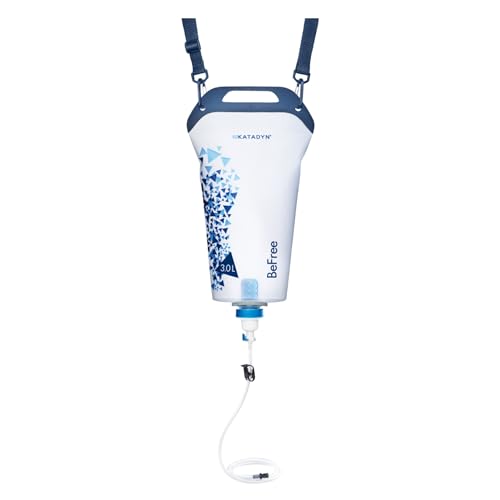
Pros
- Fast flow rate at 2 L/min
- Lightweight and packable
- Easy to clean in the field
- No pumping or power required
- Durable hollow fiber membrane
Cons
- Fill method limited to cap end
- Hanging strap can be bulky
- Not ideal for heavily cloudy water
Specifications
| Color | Clear |
|---|---|
| Size | 3L |
| Dimensions | 9 x 2.9 x 17.6 Inches |
| Weight | 0.4 Pounds |
| Product Group | Outdoors |
| Binding | Misc. |
Verify the current product variation before purchase; specifications may change.
Detailed Review
Key features from the product listing:
- Hands-free gravity operation: fill, hang, and drink without pumping or squeezing
- 0.1 micron hollow fiber membrane removes bacteria, protozoa, and sediment
- Up to 1000L capacity per filter, tested at 2 L/min flow rate
- Lightweight at 6.4 ounces and collapsible to pack flat for storage
- Easy field cleaning: shake or swish the filter to restore flow, no tools needed
- BPA-free Hydrapak Soft Flask construction for durability and flexibility
Best For / Avoid If
Best for buyers prioritizing
- Fast flow rate at 2 L/min
- Lightweight and packable
- Easy to clean in the field
Consider another option if
- Fill method limited to cap end
- Hanging strap can be bulky
- Not ideal for heavily cloudy water
Reservoir capacity and group size
Capacity determines how often someone must refill the dirty-water bag, not how much water your group needs for an entire trip. The listed systems include a 1.5-gallon bag, a 3-liter reservoir, and a 6-liter setup, so compare them against drinking, cooking, and cleanup needs.
A larger reservoir can reduce refill interruptions at a shared campsite, but takes more room when packed and filled. For canoe travel, consider whether your crew can secure a hanging point at camp and whether the full reservoir will be awkward to lift.
Filter claims and water-source risks
Hollow-fiber membranes and micron ratings describe filtration, but do not mean every product removes viruses or dissolved chemicals. The published descriptions emphasize bacteria, protozoa, sediment, taste, or other listed substances; verify exact reduction claims in current manufacturer documentation.
Clear-looking lake water can still contain pathogens, while blooms, industrial pollution, or chemical contamination may require treatment beyond a typical backpacking filter. Choose a source away from camps, livestock, and runoff, and follow local advisories rather than relying on appearance.
Flow rate and camp routine
Published flow rates offer a comparison point, not a guaranteed campsite result: sediment, filter condition, water head, and setup can affect flow. The supplied figures range from 0.5 liters per minute to 2 liters per minute, but use the manual’s guidance for realistic operation.
Gravity systems avoid pumping, which helps when preparing several bottles or filling a cooking pot. They still need a stable hanging point, a clean receiving container, and attention during filling so dirty water cannot spill into treated water.
Weight, packed shape, and hanging setup
On a canoe trip, boat capacity may make weight less restrictive than backpacking, but bags and hoses still compete for dry storage. The Platypus listing gives a system weight of 11.5 ounces; comparable weights are not supplied for every option, so avoid assuming rankings.
Check whether your intended camp has a suitable branch, pole, or other secure anchor before relying on gravity filtration. Do not suspend a filled reservoir over people, food, or fragile gear, and keep the clean-water outlet and container from contacting untreated water.
Cleaning, freezing, and storage
Maintenance differs by design. Katadyn describes shaking or swishing its filter for cleaning, while Waterdrop describes backflushing; follow each model’s manual and do not substitute a cleaning method from another filter.
Hollow-fiber elements can be damaged by freezing when wet, depending on the model and its instructions. Protect the filter from freezing conditions, drain and store it as directed, and inspect hoses, seals, and reservoirs before departure.
Filter life and replacement planning
Published capacities vary: the published descriptions list up to 1,500 gallons for Platypus, 1,400 gallons for Waterdrop, 1,320 gallons for Membrane Solutions, and 1,000 liters for Katadyn. These are manufacturer-provided figures, not a promise of service life in every water condition.
Compare replacement availability, cleaning instructions, and signs of end-of-life before choosing a system for repeated trips. Pack a backup treatment method appropriate to your route, and review our ultralight water filter guide if carrying the filter on foot matters more than camp volume.
Why You Should Trust Us
We assess the published product descriptions for capacity, stated flow, filtration claims, cleaning approach, and intended group use. We distinguish those published specifications from editorial guidance, and do not treat a listed micron rating or capacity as proof of suitability for every water source.
Some listing details are incomplete or inconsistent, including missing comparable weights and a Katadyn rating without review-count context. We avoid filling those gaps with estimates; confirm current specifications, certifications, and operating limits in manufacturer documentation before travel.
Final Thoughts
For a family or group campsite where a larger reservoir matters, the camping purifier comparison provides useful context alongside the Platypus system’s stated 6-liter reservoirs and 11.5-ounce kit weight. Its documented capacity and replaceable cartridge make it our best overall fit for shared camp water. Pros: large stated capacity, no pumping, replaceable cartridge. Cons: requires hanging space, and published performance still depends on conditions. Who should skip it: solo paddlers prioritizing the smallest, simplest setup.
For value, the Water and Safety category includes more treatment context, while the Membrane Solutions 6L Gravity Water Filter Pro pairs a 6-liter system with a stated 0.5-liter-per-minute flow and listed NSF/ANSI standards. Pros: group-oriented capacity, carbon and prefilter stages, collapsible design. Cons: slower stated flow than some listed alternatives, and certification details should be checked against current documentation. Who should skip it: paddlers seeking a compact solo bottle connection.
For compact trips, the trail filter guide helps weigh packability against camp volume. The Katadyn BeFree Gravity Water Filter 3L suits solo or small-group use based on its 3-liter bag and stated 2-liter-per-minute flow; Waterdrop offers a 1.5-gallon bag and backflushing. Pros: both avoid pumping. Cons: capacities and cleaning differ, and published documentation cannot establish a universal winner. Who should skip either: groups that need large shared batches without frequent refills.
FAQs
What makes a gravity filter useful for canoe camping?
It filters without pumping, which can simplify filling several containers at camp. You still need a secure hanging point and careful separation of dirty and treated water.
How much filter capacity does a canoe-camping group need?
Estimate drinking and cooking needs for each person, then account for refill access and camp duration. Larger reservoirs reduce refill frequency but add bulk when packed and weight when full.
Does a 0.1-micron filter remove viruses?
A 0.1-micron rating alone does not establish virus removal. Check the exact product’s documented claims and use an appropriate additional treatment when source risks require it.
Can gravity filters treat water from any lake or river?
No filter should be assumed to address every pathogen or chemical contaminant. Avoid visibly polluted sources, follow advisories, and consult the manufacturer’s stated limits.
Which listed gravity filter has the largest reservoir?
The Platypus description lists separate 6-liter dirty- and clean-water reservoirs, while Membrane Solutions lists a 6-liter system. Confirm current configuration details before purchase.
How should I clean a gravity water filter?
Use the exact model’s instructions. The published descriptions mention backflushing for Waterdrop and shaking or swishing for Katadyn, methods that should not be treated as interchangeable.
Can a wet hollow-fiber filter freeze in camp?
Freezing may damage a wet filter, depending on its design and instructions. Keep it protected from freezing and follow the maker’s draining and storage procedure.
What should I compare when choosing the best gravity water filter for canoe camping in 2026?
Prioritize group capacity, source-water suitability, cleaning, and a workable hanging setup. Then compare stated flow and packed bulk, treating manufacturer figures as reference claims rather than guaranteed results.