
For an outage kit or a car-camping setup, the best emergency generator is the one sized for your essential devices, charging opportunities, and storage space. These Jackery options range from a compact station for electronics to a much larger unit aimed at home backup.
In November 2026, this guide compares 3 configurations by capacity, output, recharging, and portability, while noting where the listing information leaves questions. For a focused comparison of smaller units, see our LiFePO4 portable power station guide.
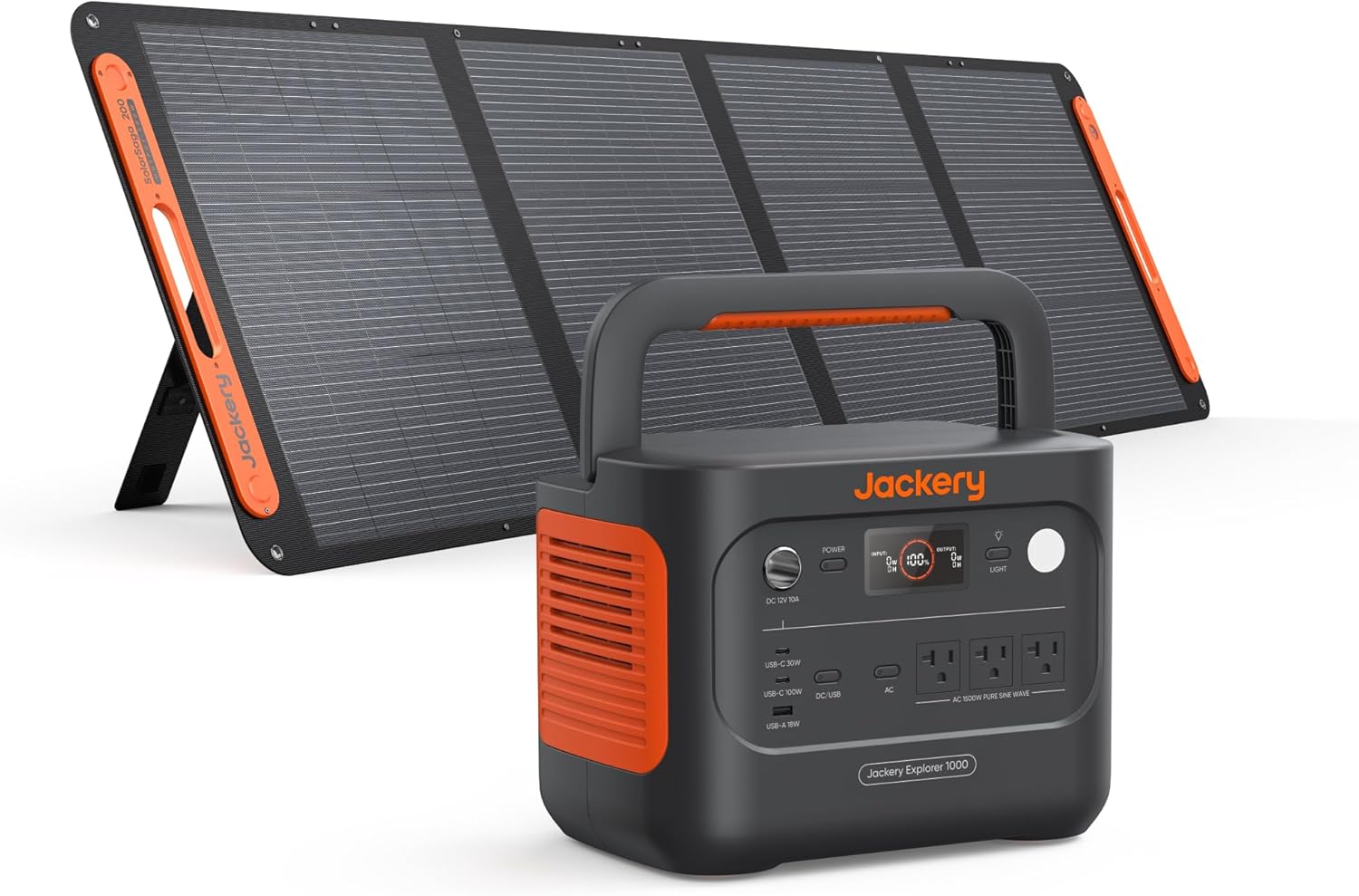
Pros
- Lightweight and portable at 23.8 lbs
- Long battery life with 4000+ cycles
- Fast 1-hour emergency charging
- 100W USB-C output for quick device charging
- Smart app control for custom modes
Cons
- Proprietary solar cable hard to replace
- 1-hour fast charge requires app activation each time
- Panel and station ship separately
Specifications
| Wattage | 1500 watts |
|---|---|
| Fuel Type | Electric |
| Power Source | Solar Powered, Battery Powered |
| Recommended Uses For Product | Residential, Camping, Roadtrip |
| Voltage | 120 volts |
| Output Wattage | 1500 watts |
| Additional Features | Fast Charging |
| Engine Type | Solar |
| Total Power Outlets | 3 |
| Current Rating | 10 A |
Verify the current product variation before purchase; specifications may change.
Detailed Review
Key features from the product listing:
- 1070Wh LiFePO4 battery lasts over 10 years with 4000+ cycles
- 1500W AC output (3000W surge) runs fridge, AC, and small appliances
- 1-hour fast charge from 0% to 100% via Jackery app (emergency mode)
- 100W USB-C PD port charges devices without extra adapters
- Compact 23.8 lb design with foldable handle for easy transport
- Smart app control for quiet overnight mode and energy efficiency

Pros
- High capacity for home backup
- Long 10-year battery lifespan
- Fast hybrid charging in 2 hours
- Portable with wheels and handle
- Quiet operation during use
Cons
- Heavy at 77 pounds
- Solar panels ship separately
- Slow solar charge in low sun
Specifications
| Other Special Features of the Product | Easy to Install |
|---|---|
| Voltage | 120 volts_of_alternating_current |
| Power Source | Battery-Powered |
| Output Wattage | 3600 |
| Number of Outlets | 4 |
| Antenna Location | Residential |
| Color | Black |
| Item Weight | 77.2 pounds |
| Unit Count | 1 Count |
| Item Dimensions | 15.2 x 12.2 x 19.3 inches |
Verify the current product variation before purchase; specifications may change.
Detailed Review
Key features from the product listing:
- Expandable capacity up to 21kWh per unit for extended backup
- 3600W AC output handles pumps, heaters, and dryers
- LFP battery with 6000 cycles and 10-year lifespan
- Charges 0-100% in 2 hours via hybrid AC+DC
- Lightest 3.6kWh LFP station at 77 lbs with wheels
- Plug-and-play setup with no complex installation
Best For / Avoid If
Best for buyers prioritizing
- High capacity for home backup
- Long 10-year battery lifespan
- Fast hybrid charging in 2 hours
Consider another option if
- Heavy at 77 pounds
- Solar panels ship separately
- Slow solar charge in low sun

Pros
- 292Wh portable power capacity
- 300W rated output
- 100W USB-C PD port
- LiFePO4 battery chemistry
- Included 40W solar panel
Cons
- Conflicting listed weights
- 40W panel charges slowly
- 600W surge output limits demanding appliances
Specifications
| Dimensions | 15.43 x 9.92 x 11.89 inches |
|---|---|
| Weight | 12.94 pounds |
| Product Group | Lawn & Patio |
| Binding | Tools & Home Improvement |
Verify the current product variation before purchase; specifications may change.
Detailed Review
Key features from the product listing:
- 292Wh capacity supports phones, cameras, laptops, and small electronics
- 300W rated output handles common camping and travel devices
- 100W USB-C PD port charges compatible laptops directly
- Six output options reduce charging conflicts at camp
- LiFePO4 battery chemistry targets over 4,000 charge cycles
- Included 40W panel reaches 80% charge in about 7.5 hours
Best For / Avoid If
Best for buyers prioritizing
- 292Wh portable power capacity
- 300W rated output
- 100W USB-C PD port
Consider another option if
- Conflicting listed weights
- 40W panel charges slowly
- 600W surge output limits demanding appliances
Start with the loads you need to power
List each device, its wattage, and how many hours you expect to use it. For battery-powered equipment, estimate watt-hours by multiplying watts by operating hours, then allow for conversion losses and periods when the device draws more power.
A phone, camera, and laptop can suit a compact station, while a refrigerator or other high-draw appliance may need substantially more capacity. Product descriptions give battery capacity and output ratings, but do not establish runtime for your specific appliances.
Separate capacity from output
Capacity, measured in watt-hours, indicates stored energy; AC output, measured in watts, limits what can run at once. Check both the appliance’s running draw and its startup surge, especially for motors, pumps, and compressor-based equipment.
The 300 model lists 292Wh and 300W rated output, while the 1000 v2 lists 1,070Wh and 1,500W output. The HomePower 3600 Plus lists 3,584Wh and 3,600W output, with higher system output described when units are operated in parallel.
Choose a capacity that matches the outage plan
For short interruptions, prioritize communications, lighting, and essential small electronics rather than trying to power an entire household. Longer outages require a realistic recharge plan and careful decisions about which devices run, and when.
The HomePower 3600 Plus is the capacity-focused option here, and its listed expansion capability may interest households planning a larger system. Its advertised household duration depends on usage assumptions, so do not treat that claim as a runtime guarantee for your home.
Consider how you will recharge
Solar can replenish a station when conditions and panel placement cooperate, but output varies with sunlight, shade, angle, and weather. A panel’s rated wattage is not a promise of constant charging power, and cloudy days can materially change the plan.
The 1000 v2 bundle includes a 200W panel, and the 300 bundle includes a 40W panel; listed charging times use particular conditions and configurations. The HomePower 3600 Plus lists AC, solar, hybrid, and gas-generator charging options, but confirm required accessories and operating instructions before relying on a method.
Balance portability against stored energy
For campsites and frequent vehicle loading, weight and handling can matter as much as capacity. The listed 300 weighs 7.5 lb, and the 1000 v2 weighs 23.8 lb; the larger HomePower uses wheels and a telescoping handle.
Wheels help on firm, accessible surfaces, but they do not make a large power station suitable for backpacking or rough trails. Choose around the distance you must carry it, available vehicle space, and whether one person can move it safely.
Check ports, battery chemistry, and ownership details
Match outlet types to your equipment before buying, including USB-C power needs, AC plugs, and any 12V accessories. The published descriptions identify LiFePO4 batteries for all three options and list different port configurations, but verify the current manual for limits and charging guidance.
Jackery describes long cycle life for these batteries and lists five years of coverage with the 1000 v2 bundle. Warranty terms, exclusions, and support arrangements can affect long-term value, so review current documentation rather than assuming every claim applies to every use.
Plan for safe electrical use
A portable battery station is not a substitute for a properly installed home backup system. Never connect a power station to household wiring through an improvised cord or outlet; use only an approved transfer arrangement installed as directed by qualified professionals.
Keep equipment dry, protect cables from damage, and follow the manufacturer’s limits for temperature, charging, and ventilation. A battery power station has no combustion exhaust during battery operation, but a separate gas generator must be used outdoors and away from doors, windows, and enclosed spaces.
Why You Should Trust Us
We compare the published product specifications and manufacturer claims with practical needs such as appliance load, charging access, transport, and intended trip or outage length. Recommendations are conditional: a higher output rating does not automatically make a unit the right choice for every household or campsite.
Where product details do not establish real-world runtime, panel performance, or compatibility, we avoid presenting those outcomes as settled facts. Before purchase, confirm current manuals, warranty terms, included accessories, and the exact equipment you intend to power.
Final Thoughts
For a flexible middle ground, the Jackery Solar Generator 1000 v2 and 200W Solar pairs 1,070Wh of capacity with 1,500W AC output, several port types, and a folding-handle power station listed at 23.8 lb. Its included solar panel and compact-for-its-capacity format make it the best overall fit here for car campers or households preparing to run selected essentials.
Who should skip it: backpackers seeking a light charging solution, or anyone expecting it to power large appliances for extended periods without recharging. The Jackery Solar Generator 300 and 40W Solar is the value-oriented choice for smaller electronics and brief trips, with 292Wh capacity and 300W rated output, but it is not a substitute for a larger outage reserve.
Who should skip it: buyers who need substantial appliance capacity or long runtimes between charging opportunities. For a home-focused setup, the Jackery HomePower 3600 Plus Portable Power Station offers 3,584Wh, 3,600W output, and expansion options, but its size and home-backup emphasis make it excessive for many camping kits. Compare it with our portable power station guidance for winter camping and browse the Power and Lighting category for related gear.
FAQs
What is the best emergency generator for camping?
It depends on your load and how far you carry it. The 300 suits light electronics, while the 1000 v2 provides more capacity and output for car-camping needs.
Can a portable power station run a refrigerator?
Possibly, if its continuous and startup power requirements fit the station and its available energy lasts long enough. Check the refrigerator’s actual power draw and use a measured consumption estimate rather than assuming a fixed runtime.
How much battery capacity do I need for an outage?
Add the watt-hours needed by your priority devices over the period between recharges, then include a margin for conversion losses. Your answer changes with appliance duty cycles, temperature, and how much solar or other charging is available.
Can solar panels recharge a power station during cloudy weather?
They may produce some power, but output can fall considerably with cloud cover, shade, and poor panel orientation. Keep an alternate charging plan for essential equipment during extended bad weather.
Is the Jackery 300 suitable for emergency home backup?
It can support some small electronics, but its listed 292Wh capacity and 300W output limit the loads and duration. It is better treated as a compact power source than as household backup for major appliances.
Can a power station be connected to a home’s electrical panel?
Do not improvise a connection to home wiring. Use only a compatible, approved transfer setup installed and operated according to its instructions by a qualified professional.
What makes an emergency generator a good fit for winter camping?
Consider cold-weather operating limits, capacity, charging options, and the energy needs of your devices. Our rechargeable amber camping lantern guide can also help you plan lighting without relying solely on a power station.