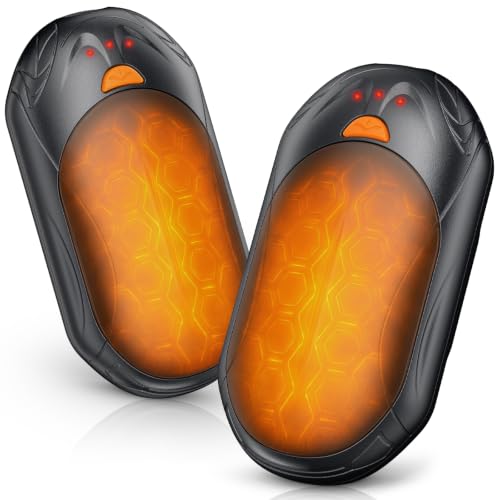

Cold fingers make small camp cooking tasks harder, from opening a fuel canister to handling utensils. Top rechargeable hand warmers for winter camp cooking breaks can provide portable warmth during pauses, but they are not a replacement for insulated gloves or safe stove technique.
This guide compares two listed models by stated battery capacity, heat settings, runtime claims, charging information, and design. For the wider cold-weather sleep system, see our guide to insulated sleeping pads.

Pros
- Two warmers per set
- Three selectable heat settings
- Temperature and battery display
- Listed 8–12-hour room-temperature runtime
- Compact, lightweight design
Cons
- Cold-weather runtime not specified
- Full recharge takes up to four hours
- No user reviews listed
Specifications
| Color | Black |
|---|---|
| Size | 2 Pack |
| Product Group | Outdoors |
Verify the current product variation before purchase; specifications may change.
Detailed Review
Key features from the product listing:
- Two separate warmers let you heat both hands or share one.
- Three settings, from 113°F to 131°F, support adjustable warmth.
- LED display shows selected temperature and remaining battery power.
- Each warmer has a listed 3,200mAh battery and 8–12-hour room-temperature runtime.
- Listed 0.15-pound weight and 0.63-inch thickness suit pockets and gloves.
- Reusable design is rated for over 300 charge cycles.
Best For / Avoid If
Best for buyers prioritizing
- Two warmers per set
- Three selectable heat settings
- Temperature and battery display
Consider another option if
- Cold-weather runtime not specified
- Full recharge takes up to four hours
- No user reviews listed

Pros
- Up to 15 hours of heat
- Five heat levels to 131°F
- Heats in about 3 seconds
- Built-in emergency light
- Splits into two warmers
Cons
- 131°F max may feel modest in deep cold
- Charging time not specified
- Only available in black
Specifications
| Color | Black |
|---|---|
| Size | 1.9 centimeters |
| Product Group | Sports |
| Binding | Sports |
Verify the current product variation before purchase; specifications may change.
Detailed Review
Key features from the product listing:
- A 6000mAh battery across the pair delivers up to 15 hours of warmth per charge, enough to cover a full day outside
- Five heat levels reaching up to 131°F let you match output to conditions instead of settling for one fixed temperature
- One-touch activation heats in about 3 seconds, so warmth is ready before your gloves come off
- The snap-together design works as two separate warmers or one combined unit for shared heat in a pocket or sleeping bag
- Five indicator lights show remaining battery and heat setting at a glance, removing guesswork before you head out
- An integrated emergency light adds backup illumination for campsites, trailheads, and car emergencies
Best For / Avoid If
Best for buyers prioritizing
- Up to 15 hours of heat
- Five heat levels to 131°F
- Heats in about 3 seconds
Consider another option if
- 131°F max may feel modest in deep cold
- Charging time not specified
- Only available in black
Heat settings and control
Control matters when you alternate between cooking and other camp tasks. Fussion lists three settings at 113°F, 122°F, and 131°F, while DeeKom describes five temperature levels and a maximum of 131°F.
More levels may help you adjust warmth, but published details do not give DeeKom’s individual temperatures. Start at a comfortable setting, keep the warmer away from bare skin for prolonged contact, and follow its manual.
Battery capacity and runtime claims
Fussion specifies 3,200mAh per warmer, 6,400mAh across its pair, and an 8 to 12 hour runtime measured at room temperature. DeeKom lists 6,000mAh and claims 7 to 15 hours, without clarifying in the listing information whether capacity describes each unit or the pair.
Those manufacturer figures do not establish cold-weather runtime. Low temperatures and higher heat settings can affect battery performance, so treat the claims as comparison points, not a promise for a full winter outing.
Charging and camp power
Fussion states a four-hour full recharge and includes a dual USB-C charging cable. DeeKom’s published details do not specify recharge time or cable type, which leaves less information for planning between trips.
Charge devices before departure and keep them dry during use. If relying on a battery bank or vehicle outlet, confirm cable compatibility and reserve power for essential equipment rather than assuming a warmer can recharge conveniently at camp.
Shape, portability, and cooking workflow
Fussion reports each unit weighs 0.15 lb and measures 0.63 inches thick. DeeKom describes a lightweight design with a snap-on connection, but the listing information gives no weight or dimensions for a direct pack-space comparison.
For meal breaks, a pair can let you warm both hands between tasks, but keep warmers clear of flame, hot cookware, and food-contact surfaces. Stow them where they remain accessible without cluttering the stove area.
Safety claims, indicator, and extra features
Fussion lists overheating, overcharge, and short-circuit protection, plus UL, FCC, CE, and UKCA certifications. DeeKom claims UL, CE, and FCC certifications and includes battery and heating indicator lights; verify markings and instructions on the product itself.
DeeKom also lists an emergency light, but a small integrated light should not replace a headlamp for cooking or moving around camp. Neither product’s published details establish water resistance, so protect both from snow, rain, and spills.
Ownership, limits, and value
Fussion claims more than 300 charge cycles, while the supplied DeeKom details provide no cycle-life figure. Neither claim describes warranty coverage, replacement batteries, or repair options, so check current manufacturer documentation before purchase.
Fussion gives clearer per-unit capacity, charging time, dimensions, and stated protection features. DeeKom offers more heat levels and an emergency light, but buyers should accept more uncertainty around its capacity breakdown and charging details.
Why You Should Trust Us
Our comparison uses only the product information available for these models. We separate manufacturer statements, such as runtime, certifications, and cycle life, from practical interpretation about cold-weather use.
Where important details are missing, we say so instead of filling gaps with assumptions. We do not treat room-temperature runtime claims as winter field results, and we recommend checking current product manuals for charging and safety directions.
Final Thoughts
For best overall fit based on the published details, AI Electric Hand Warmers Rechargeable 2 Pack is the more transparent choice for planning: its per-unit capacity, stated recharge time, weight, thickness, and three heat settings are specified. Its main drawback is fewer heat levels than DeeKom, and room-temperature runtime may not match cold camp conditions.
As a value-oriented option, DeeKom Rechargeable Hand Warmers 2 Pack,15H*2 Long suits campers who prioritize five heat levels and an integrated light. Its stated capacity basis, charging time, and exact dimensions are not provided here. Skip it if those specifications are essential to your trip plan.
For specific use during brief cooking pauses, DeeKom’s light may be convenient as a backup, while Fussion’s clearer charging details favor predictable preparation. Neither is a substitute for gloves, a primary headlamp, or a dry storage plan; our guide to packing wet winter gear covers moisture management after camp.
FAQs
Are rechargeable hand warmers useful for winter camp cooking breaks?
They can warm hands during pauses, but they do not replace insulated gloves or careful handling around hot cookware. Keep electronics away from flame, water, and food preparation surfaces.
Which option gives more heat settings?
DeeKom lists five temperature levels. Fussion lists three settings at 113°F, 122°F, and 131°F, giving buyers specific stated temperatures.
Will the stated runtime hold in freezing weather?
That is not established by the listing information. Fussion’s 8 to 12 hour figure is specified at room temperature, and DeeKom’s 7 to 15 hour claim lacks a stated test condition.
Can I use a hand warmer while cooking?
Use it between tasks, not where it could contact flame, hot cookware, fuel, or food. Keep attention on stove operation and follow the warmer’s manual.
Does either model include a light?
DeeKom lists an emergency light. Its output and runtime are not specified in the published details, so carry a separate headlamp for cooking and camp movement.
What should I check before buying rechargeable hand warmers?
Check capacity basis, charging time, cold-weather limitations, controls, safety instructions, and whether the device suits your gloves and pockets. Also confirm what the warranty covers.
Are these hand warmers water-resistant?
No water-resistance rating appears in the published product details. Keep either unit protected from snow, rain, and cooking spills, and do not charge it while wet.
What should I pack alongside a hand warmer for winter camp?
Pack suitable gloves, a reliable light, and dry storage. For sleep-system planning, consult our winter sleeping bag guide, since hand warmers cannot replace insulation matched to conditions.
What makes top rechargeable hand warmers for winter camp cooking breaks different?
Among these listed options, Fussion provides more specific charging and size information, while DeeKom offers more heat levels and a stated light feature. Choose based on which confirmed details match your routine.