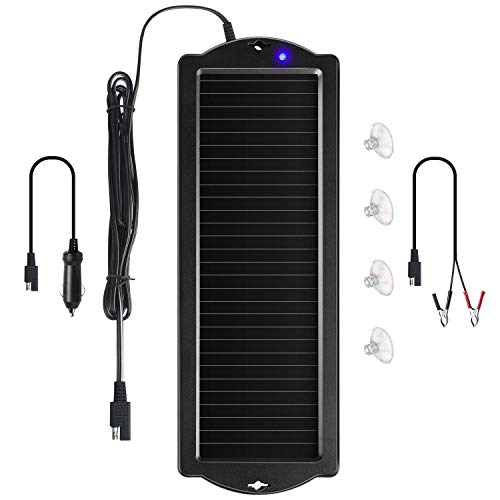
Solar panel labels describe electrical output under stated conditions, not a promise of identical performance at every campsite. Understanding voltage, current, and power helps you check compatibility with a charge controller, battery, or measuring device before connecting equipment.
This guide explains common label values and reviews two watt meters whose supplied descriptions include different measurement details. For broader campsite power planning, see our guide to choosing a camping power station size.
Start with the panel label or manufacturer data sheet. Find maximum power voltage and current, open-circuit voltage, and short-circuit current, often abbreviated Vmp, Imp, Voc, and Isc.

Pros
- Measures five electrical and discharge values
- 200A maximum current rating
- Backlit display
- Compact listed dimensions
- Listed for solar, wind, and RC use
Cons
- Connector compatibility must be verified
- Minimum operating voltage is 4.8V
- Rated limits are below 100V and 200A
Specifications
| Color | Blue |
|---|---|
| Size | 200A |
| Dimensions | 4.724409444 x 1.968503935 x 1.181102361 inches |
| Weight | 0.220462262 pounds |
| Product Group | BISS |
| Binding | Kitchen |
Verify the current product variation before purchase; specifications may change.
Detailed Review
What stands out in the currently available product data:
- Tracks voltage, current, power, capacity, and discharge time in one meter
- Measures current up to 200A for checking compatible battery-powered equipment
- Displays voltage up to 100V and power up to 6554W
- Backlit screen supports reading measurements in low-light conditions
- Useful for evaluating solar, wind, RC battery, and other listed systems
- Compact body measures about 4.72 × 1.97 × 1.18 inches
Best For / Avoid If
Best for buyers prioritizing
- Measures five electrical and discharge values
- 200A maximum current rating
- Backlit display
Consider another option if
- Connector compatibility must be verified
- Minimum operating voltage is 4.8V
- Rated limits are below 100V and 200A

Pros
- Voltage, current, power, and capacity readings
- Listed 200A rating
- Compact, lightweight design
- Adjustable-contrast LCD
- Photovoltaic connectors included
Cons
- 1A steps limit low-current detail
- Voltage range not specified
- Verify wiring and connector compatibility
Specifications
| Color | 200A Yellow |
|---|---|
| Size | yellow 200A |
| Dimensions | 3.93700787 x 1.968503935 x 1.968503935 inches |
| Weight | 0.29541943108 pounds |
| Product Group | BISS |
| Binding | Kitchen |
Verify the current product variation before purchase; specifications may change.
Detailed Review
What stands out in the currently available product data:
- Track voltage, current, power, capacity, and discharge time from one display
- Listed 200A rating supports evaluation of higher-current setups when system compatibility is confirmed
- 1A measurement steps suit broad current checks better than fine low-current monitoring
- Adjustable-contrast LCD supports viewing across different lighting conditions, according to the listing
- Compact listed dimensions and weight suit portable field checks
- Photovoltaic connectors are listed as included for solar-panel use
Best For / Avoid If
Best for buyers prioritizing
- Voltage, current, power, and capacity readings
- Listed 200A rating
- Compact, lightweight design
Consider another option if
- 1A steps limit low-current detail
- Voltage range not specified
- Verify wiring and connector compatibility
Understand Vmp and Imp
Vmp is voltage at the panel’s maximum power point under specified test conditions. Imp is current at that same point, so multiplying Vmp by Imp gives approximate rated maximum power in watts.
For example, a hypothetical panel labeled 18 volts Vmp and 5 amps Imp produces about 90 watts at that operating point. Real output changes with sunlight, panel temperature, shading, orientation, and system load.
Check Voc and Isc for equipment limits
Voc is open-circuit voltage measured with no load connected. Isc is short-circuit current measured under specified conditions; neither value represents the panel’s normal loaded operating point.
Use Voc when checking a controller’s maximum solar input voltage, and include the manufacturer’s temperature guidance. Cold conditions can raise panel voltage, so a rating that barely fits at moderate temperatures may exceed equipment limits.
Use Isc and the controller or equipment manual when checking current limits. Never short a panel to take a reading unless the meter and procedure are explicitly rated for that work.
Separate voltage, current, and watts
Voltage describes electrical potential, current describes flow, and watts describe power. For a DC circuit, watts equal volts multiplied by amps at the same measurement point and time.
A panel connected to a charge controller may show different voltage and current from its label because the controller changes the operating point. Battery-side readings also differ from panel-side readings, so record where each meter sits.
Match panel ratings to controller input
Check controller maximum PV voltage, allowable input current or power, and supported battery voltage. For series-connected panels, voltages add; for parallel-connected panels, currents add, subject to wiring and equipment limits.
Use the controller manual rather than assuming a watt rating alone proves compatibility. For a portable setup, also confirm connector type, polarity, cable gauge, and whether the controller accepts the panel’s voltage range.
Read meter range, resolution, and accuracy
Range is the highest value the meter is specified to measure, while resolution is the smallest displayed increment. Accuracy describes expected measurement error under stated conditions; resolution does not guarantee accuracy.
Product descriptions supplied for the 200A Digital Watt Meter Solar Panel Power Analyzer list 0 to 100 volts and 0 to 200 amps, with a stated 4.8-volt minimum operating requirement. They also give a separate 4.8 to 60-volt range and mention an optional auxiliary battery for 12 to 100 volts, so verify the manual and wiring diagram before use.
The 200A RC Watt Meter Power Analyzer for Solar Wind description claims readings for voltage, current, watts, capacity, and time, plus ±1% accuracy and 1A step size. That stated step size may be too coarse for evaluating small panel currents, and supplied details do not clarify measurement range or operating voltage.
Measure safely and compare like with like
Connect meters only according to their instructions. An inline current meter must be placed in series with the circuit, while voltage is measured across the intended points; incorrect wiring can damage equipment or create a hazard.
Stay within every meter, connector, and cable rating, and disconnect power before changing wiring when the equipment instructions require it. Do not exceed stated voltage or current limits, and seek qualified help if the circuit layout is unclear.
Why You Should Trust Us
We base this comparison on the supplied product descriptions and standard meanings of common solar electrical ratings. We have not independently verified either meter’s accuracy, construction, included connectors, or compatibility with a specific panel or controller.
Where product details conflict or omit important limits, we identify that uncertainty rather than treating marketing specifications as confirmed performance. Check the current product manual and your equipment documentation before making a connection.
Final Thoughts
The 200A Digital Watt Meter Solar Panel Power Analyzer appears the more informative option on paper because its description gives voltage, current, power, and capacity ranges. However, its differing voltage statements make manual verification essential before purchase or use.
The 200A RC Watt Meter Power Analyzer for Solar Wind may suit users who need voltage, current, power, and discharge tracking across hobby or solar applications. Its described 1A step size is a meaningful limitation when monitoring low-current panel output, and accuracy claims remain unverified.
Neither listing supports a confident universal best-overall or best-value verdict without verified manuals, connector details, and test evidence. Compare required voltage and current ranges first; then review our Power and Lighting guides and compact camping lantern guide for related campsite equipment planning.
FAQs
What does Vmp mean on a solar panel?
Vmp is voltage at the panel’s maximum power point under specified test conditions. It pairs with Imp to calculate approximate rated power.
What is the difference between Voc and Vmp?
Voc is open-circuit voltage with no load, while Vmp is voltage at the maximum power point. Use Voc when checking maximum controller input voltage.
How do I calculate solar panel watts from volts and amps?
Multiply voltage by current measured at the same operating point. For example, 18 volts multiplied by 5 amps equals 90 watts.
Does a solar panel always produce its label wattage?
No. Rated output applies under stated test conditions; sunlight, temperature, shading, angle, and connected equipment affect actual output.
Should I use Isc or Imp to choose a charge controller?
Check the controller manual for its specific input-current limits and required calculation method. Also account for panel configuration and temperature-related voltage changes.
Can I connect a watt meter directly to a solar panel?
Only if the meter instructions specify a compatible connection and the panel stays within every rated limit. Follow the wiring diagram and observe polarity.
What should I check before buying a solar watt meter?
Confirm voltage and current range, resolution, accuracy conditions, connector type, wiring limits, and operating-power requirements. Resolve conflicting specifications using the manufacturer’s manual.
Why does my meter show different readings from the panel label?
The label reflects specified test conditions, while field readings vary with light, temperature, shading, and load. Confirm measurement location and compare values under similar conditions.