A solar panel’s wattage describes output under specified test conditions, not a charging rate you should expect throughout a camping day. If your panel seems slow, check sunlight, angle, shading, connections, and the battery or device receiving power before blaming the panel.
This guide focuses on small 12-volt solar battery maintainers, including two Sunway Solar models with different stated maximum outputs. For broader campsite power planning, see our guide to choosing a camping power station.
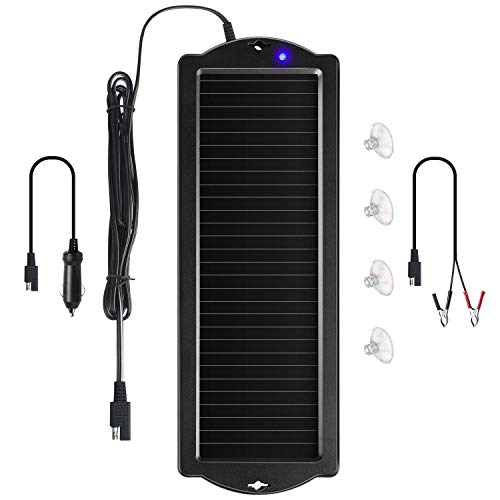
Pros
- Cigarette-lighter plug and battery clamps
- Built-in reverse-charging protection
- Blinking charge indicator
- Compact panel with suction cups
Cons
- Low output is not for rapid charging
- Listed power differs: 1.5W and up to 1.8W
- Cigarette-lighter connection depends on vehicle outlet behavior
Specifications
| Color | Black |
|---|---|
| Size | 1.5W |
| Dimensions | 0.5 x 13.98 x 5 inches |
| Weight | 1.4109584768 Pounds |
| Product Group | Lawn & Patio |
| Binding | Lawn & Patio |
Verify the current product variation before purchase; specifications may change.
Detailed Review
What stands out in the currently available product data:
- Up to 1.8W solar output helps offset battery drain during storage.
- Amorphous panel is specified to work in cloudy conditions.
- Cigarette-lighter plug and battery clamps offer two connection options.
- Built-in blocking diode helps prevent reverse charging.
- Blinking LED indicates charging activity.
- Suction cups support mounting on a windshield or dashboard.
Best For / Avoid If
Best for buyers prioritizing
- Cigarette-lighter plug and battery clamps
- Built-in reverse-charging protection
- Blinking charge indicator
Consider another option if
- Low output is not for rapid charging
- Listed power differs: 1.5W and up to 1.8W
- Cigarette-lighter connection depends on vehicle outlet behavior
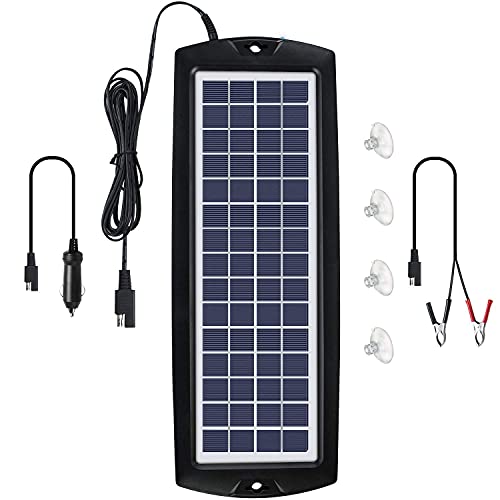
Pros
- 4W output for maintenance charging
- Cigarette-lighter adapter and alligator clamps
- Built-in reverse-charging protection
- Compact panel dimensions
- 12-month warranty
Cons
- Best suited to offsetting small, steady drains
- Charging depends on available sunlight
- No charge-rate or runtime details supplied
Specifications
| Color | Black |
|---|---|
| Size | 4W |
| Dimensions | 13.9 x 5 x 0.5 Inches |
| Weight | 1.435650250144 Pounds |
| Product Group | Lawn & Patio |
| Binding | Automotive |
Verify the current product variation before purchase; specifications may change.
Detailed Review
What stands out in the currently available product data:
- Helps offset steady drain from clocks and alarms on stored vehicles
- Includes cigarette-lighter adapter and alligator clamps for two connection options
- Built-in diode helps prevent reverse charging
- Compact 13.9 x 5 x 0.5-inch panel fits vehicle storage setups
- ABS housing and PV glass cover support a low-maintenance design
- Listed for several 12V battery types, including AGM and LiFePO₄
Best For / Avoid If
Best for buyers prioritizing
- 4W output for maintenance charging
- Cigarette-lighter adapter and alligator clamps
- Built-in reverse-charging protection
Consider another option if
- Best suited to offsetting small, steady drains
- Charging depends on available sunlight
- No charge-rate or runtime details supplied
Why does my solar panel charge slower than its rating?
Usually, conditions at the panel differ from the controlled conditions used to state its maximum power. The rating is not a guaranteed daily energy yield or a promise that a connected battery will accept power at that rate.
Understand the difference between watts and charging speed
Watts measure power at a moment; watt-hours measure energy delivered over time. A panel labeled up to 1.8 watts or 4 watts can produce less when sunlight, orientation, temperature, or electrical conditions differ from its rating conditions.
Charging speed also depends on the battery’s voltage and state of charge, plus losses along the electrical path. A maintainer is intended to offset small ongoing drains, not quickly refill a depleted vehicle battery.
Check direct sunlight, shade, and panel angle
Clouds reduce available sunlight, and even a narrow shadow from a roofline, tree branch, or dashboard trim can lower panel output. Move the panel to a spot with unobstructed light and check it again as the sun moves.
Glass can also reduce the sunlight reaching a panel. These maintainers are described for placement on a vehicle windshield or dashboard, but output through glass can differ from direct outdoor exposure; follow product instructions and do not leave equipment where heat or visibility becomes a concern.
Inspect connectors and the vehicle’s 12-volt outlet
Confirm the plug is fully seated, cables are undamaged, and clamps have clean, secure contact when using battery terminals. Loose connections, corrosion, or a vehicle outlet that is not connected to the battery can interrupt charging.
Check the vehicle manual before relying on its cigarette-lighter-style outlet. Outlet behavior varies by vehicle, and some outlets switch off with the ignition; a direct battery connection may be more suitable when permitted by the charger instructions.
Consider battery condition and charge acceptance
A battery near full charge may accept little current, even when the panel is producing power. Conversely, a deeply discharged, aging, damaged, or unusually cold battery may not respond as expected to a small maintainer.
Use a suitable battery monitor or multimeter only if you know how to measure safely and interpret the reading. Stop if a battery is swollen, leaking, unusually hot, or damaged, and seek qualified service rather than trying to revive it with a small solar panel.
Match panel output to the job
The supplied product details list one Sunway Solar model at up to 1.8 watts and another at up to 4 watts. The higher stated maximum may offer more headroom for maintaining a compatible battery, but it does not guarantee a particular charging time.
Both are described as 12-volt battery maintainers for managing small, steady drains. Neither product description supplies measured output under specific sunlight conditions, so compare stated ratings as manufacturer claims, not independent performance results.
Verify compatibility and safety protections
Check battery chemistry, nominal voltage, connection method, and the charger’s instructions before connecting anything. The 4-watt model’s listing names several battery chemistries, while the 1.8-watt listing refers generally to rechargeable 12-volt batteries; that wording alone does not confirm compatibility with every battery or charging system.
The listings describe built-in blocking diodes to prevent reverse current, but do not treat that feature as a substitute for correct connection or battery-specific charging controls. For larger loads or routine battery recovery, choose a charger designed for that task and chemistry.
Use a repeatable check before replacing equipment
Test in a consistent location and time window, with the panel clean, fully exposed to sunlight, and connected securely. Note cloud cover, shadows, panel position, battery state, and indicator behavior so a changing condition does not look like a faulty product.
Allow for natural changes in sunlight rather than judging performance from a brief glance. If output remains unexpectedly low under clear, direct light, inspect the cable and connection, consult the manual, and contact the manufacturer about warranty coverage or troubleshooting.
Why You Should Trust Us
We base this comparison on the product details supplied for each model and general solar charging principles. The listed maximum outputs, intended uses, connection options, and protection features are manufacturer-provided claims, not measurements from our own testing.
We separate those stated features from practical interpretation: more rated wattage can provide more potential output, but actual charging depends on sunlight, placement, connections, and battery acceptance. The available information does not establish comparative field performance, exact charging times, or suitability for every battery chemistry.
Final Thoughts
For maintaining a compatible 12-volt battery against small parasitic drains, the Sunway Solar Solar Car Battery Trickle Charger rated up to 4 watts is the stronger on-paper choice. Its higher stated maximum and listed battery chemistry range make it the more flexible option in this pair, subject to confirming compatibility in the instructions.
The Sunway Solar Car Battery Trickle Charger rated up to 1.8 watts may suit a vehicle owner seeking a lower-output maintainer for a modest, steady drain. The supplied details describe an amorphous panel and a blinking charging indicator, but do not establish how it performs in any particular cloudy condition.
Neither model is a substitute for a properly sized battery charger when you need to recover a depleted battery. For campsite lighting and larger electrical needs, compare options in our camping lantern guide or review the site’s Power and Lighting category.
FAQs
Why does my solar panel never reach its rated watts?
The rating represents output under specified test conditions. Shade, clouds, panel angle, glass, temperature, cable losses, and the connected battery can all reduce observed output.
Can a small solar maintainer charge a dead car battery?
These products are described as maintainers for small, steady drains, not fast recovery chargers. A deeply discharged battery may need diagnosis and a charger designed for its chemistry and condition.
Does a solar panel work through a car windshield?
Sunway Solar describes dashboard or windshield placement, but light passing through glass can reduce available output. Compare performance with the panel in unobstructed sunlight when safe and practical, while following product instructions.
Does cloudy weather explain slow solar charging?
Yes. Cloud cover lowers the sunlight reaching a panel, so output can fall below its stated maximum; the amount depends on conditions and cannot be determined from the product rating alone.
How can I tell whether my solar charger is working?
Check the indicator described for your model, inspect connections, and measure safely with an appropriate meter if you understand the procedure. An indicator is not a precise measurement of charging current or battery recovery.
Is the higher-wattage Sunway Solar model always faster?
Its listed maximum is higher, which suggests greater potential output under comparable conditions. Actual charging speed still depends on sunlight, wiring, battery state, and compatibility, so the rating alone cannot establish a charging-time advantage.
Can I leave a solar maintainer connected all the time?
Follow the manufacturer’s instructions and confirm compatibility with the battery and connection method. The 4-watt listing makes a no-overcharge claim for batteries of at least 20 amp-hours, but do not generalize that claim to other capacities or models.
What should I check before replacing a slow solar panel?
First rule out shade, dirty surfaces, loose connections, unsuitable outlet behavior, and a battery that is already full or unwell. For broader power planning, the camping power station size comparison can help distinguish battery maintenance from campsite energy needs.