
When winter trails, icy access roads, or frozen campsites are on your route, footwear traction can help you move with more confidence. These 6 options range from compact everyday cleats to trail-focused designs, so the right choice depends on your boots, terrain, and trip frequency.
Our comparison includes products from Kahtoola, Sfee, Cimkiz and more and covers the differences that matter on foot: spike layout, harness design, portability, and intended terrain. For broader cold-weather preparation, pair your traction choice with suitable insulated sleeping pad guidance.

Pros
- 12 stainless-steel spikes per foot
- Compact stated pack size
- Flexible chain construction
- Cold-rated elastomer harness
- Four-year manufacturer warranty
Cons
- Requires correct sizing for secure fit
- Not intended for technical climbing
- Skip if you need traction for bare pavement
Specifications
| Color | Black |
|---|---|
| Size | Medium |
| Dimensions | 8 x 9 x 10 inches |
| Weight | 0.881849048 pounds |
| Product Group | Outdoors |
| Binding | Apparel |
Verify the current product variation before purchase; specifications may change.
Detailed Review
Key features from the product listing:
- Eight forefoot spikes and four heel spikes provide traction across the stride.
- Stainless-steel chains add grip while staying flexible and packable.
- The elastomer harness is designed to remain stretchy down to -22°F.
- A toe bail and reinforced eyelets help limit harness stress and toe push-through.
- The stated 5 x 3 x 2-inch pack size fits easily in a winter kit.
- Designed for hiking shoes and boots on mountain trails and other icy outings.
Best For / Avoid If
Best for buyers prioritizing
- 12 stainless-steel spikes per foot
- Compact stated pack size
- Flexible chain construction
Consider another option if
- Requires correct sizing for secure fit
- Not intended for technical climbing
- Skip if you need traction for bare pavement

Pros
- 19 stainless steel spikes per foot
- Flexible TPE construction
- Adjustable securing strap
- Includes a carry bag
Cons
- X-Large size may not fit smaller footwear
- Fit and traction depend on shoe shape and surface
- Who should skip it: users needing technical climbing crampons
Specifications
| Color | Blue |
|---|---|
| Size | X-Large |
| Weight | 0.59 pounds |
| Product Group | Outdoors |
| Binding | Sports |
Verify the current product variation before purchase; specifications may change.
Detailed Review
Key features from the product listing:
- Nineteen stainless steel spikes per foot provide multiple points of contact on icy surfaces
- Chain links connect the spikes across the sole
- Stretchy TPE construction is designed to fit over hiking shoes and boots
- An adjustable strap helps secure the cleats around footwear
- Flexible design packs into the included carry bag
- X-Large sizing is intended for larger footwear
Best For / Avoid If
Best for buyers prioritizing
- 19 stainless steel spikes per foot
- Flexible TPE construction
- Adjustable securing strap
Consider another option if
- X-Large size may not fit smaller footwear
- Fit and traction depend on shoe shape and surface
- Who should skip it: users needing technical climbing crampons

Pros
- Two pairs included
- Flexible TPE construction
- Fits listed adult size range
- Folds for pack storage
- Designed for multiple winter activities
Cons
- Spike count differs between title and description
- No stated technical-terrain or steep-slope suitability
- Who should skip it: technical hikers and users needing verified traction
Specifications
| Color | black |
|---|---|
| Size | Women: 6-12, Men: 5-10 |
| Dimensions | 8.5 x 3.1 x 0.0393700787 inches |
| Product Group | Sports |
| Binding | Sports |
Verify the current product variation before purchase; specifications may change.
Detailed Review
Key features from the product listing:
- Two pairs let you outfit a spare set of shoes or share a pair
- Stretch-on TPE construction fits the listed range of adult shoe sizes
- Front-and-heel attachment is designed for quick on-and-off use
- Foldable design can be packed in a daypack after use
- Steel spikes are intended to add grip on icy and snowy surfaces
- Listed for everyday winter activities including walking, hiking, and snow shoveling
Best For / Avoid If
Best for buyers prioritizing
- Two pairs included
- Flexible TPE construction
- Fits listed adult size range
Consider another option if
- Spike count differs between title and description
- No stated technical-terrain or steep-slope suitability
- Who should skip it: technical hikers and users needing verified traction
Pros
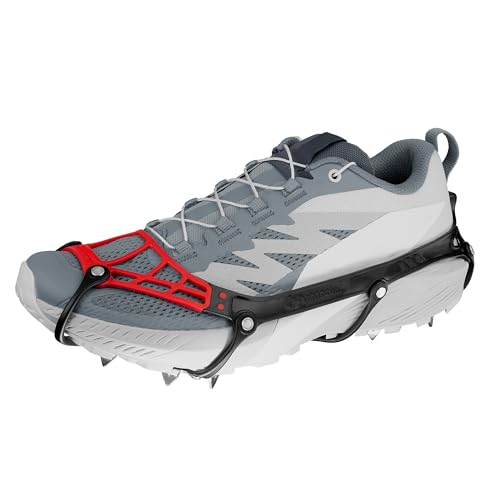
- Lightweight TPU spike construction
- Twelve spikes per foot
- Flexible hybrid elastomer harness
- Articulating rivets help shed snow
- Four-year manufacturer warranty
Cons
- X-Small sizing limits footwear compatibility
- No steel chains
- Who should skip it: hikers needing another size or chain-style traction
Specifications
| Color | Lava |
|---|---|
| Size | X-Small |
| Dimensions | 7 x 4 x 4 inches |
| Product Group | Outdoors |
| Binding | Sports |
Verify the current product variation before purchase; specifications may change.
Detailed Review
Key features from the product listing:
- TPU construction is described as over 43% lighter than the original MICROspikes, making the set easier to pack.
- Twelve spikes per foot, split between forefoot and heel, are designed to provide traction on icy, uneven ground.
- A flexible TPR toe and TPE heel harness is intended to fit flexible trail-running and lightweight hiking footwear.
- Articulating rivets let spikes move independently, a design intended to help shed snow and limit buildup.
- Reinforced harness eyelets target durability at key stress points without adding bulk.
- A raised heel tab makes the traction devices easier to put on and remove, including while wearing gloves.
Best For / Avoid If
Best for buyers prioritizing
- Lightweight TPU spike construction
- Twelve spikes per foot
- Flexible hybrid elastomer harness
Consider another option if
- X-Small sizing limits footwear compatibility
- No steel chains
- Who should skip it: hikers needing another size or chain-style traction

Pros
- 12 spikes per foot
- Mixed-terrain traction design
- Flexible cold-weather TPE harness
- Open design sheds snow
- Four-year manufacturer warranty
Cons
- Sizing requires checking the chart
- Shoes or boots not included
- Skip it for use without compatible footwear
Specifications
| Color | Blue |
|---|---|
| Size | Medium |
| Dimensions | 10 x 3 x 8 inches |
| Weight | 0.5 pounds |
| Product Group | Sports |
| Binding | Sports |
Verify the current product variation before purchase; specifications may change.
Detailed Review
Key features from the product listing:
- Twelve spikes per foot combine carbide tips, aluminum steps, and TPU lugs for varied winter terrain.
- Open design is intended to shed snow quickly and fit flexible footwear.
- Stretchy TPE harness is specified to remain flexible down to -22°F.
- Reinforced eyelets add support at key harness stress points.
- Lightweight design weighs 0.5 lb, according to the provided specifications.
- Designed for winter hiking, backpacking, and trail running on icy or mixed trails.
Best For / Avoid If
Best for buyers prioritizing
- 12 spikes per foot
- Mixed-terrain traction design
- Flexible cold-weather TPE harness
Consider another option if
- Sizing requires checking the chart
- Shoes or boots not included
- Skip it for use without compatible footwear

Pros
- 19 stainless steel spikes
- Forefoot and heel coverage
- Stretchy TPE slip-on band
- Storage bag and straps included
- Listed for US sizes 8-11
Cons
- Fit limited to listed US sizes 8-11
- Spike cleats are unsuitable for indoor floors
- Skip if you need technical mountaineering crampons
Specifications
| Color | Orange |
|---|---|
| Size | Large(US:8-11) |
| Weight | 0.9700339528 pounds |
| Product Group | Sports |
| Binding | Apparel |
Verify the current product variation before purchase; specifications may change.
Detailed Review
Key features from the product listing:
- Nineteen spikes are distributed across the forefoot and heel for traction in multiple directions.
- Stainless steel chains and claws are specified for resistance to corrosion.
- Stretchy TPE bands fit over compatible shoes or boots.
- Heel tabs and included straps are intended to help keep the cleats in place.
- The included storage bag makes them easier to carry between outings.
- Listed for activities including winter walking, dog walking, and ice fishing.
Best For / Avoid If
Best for buyers prioritizing
- 19 stainless steel spikes
- Forefoot and heel coverage
- Stretchy TPE slip-on band
Consider another option if
- Fit limited to listed US sizes 8-11
- Spike cleats are unsuitable for indoor floors
- Skip if you need technical mountaineering crampons
Match traction to the terrain
For sustained icy trails and steeper winter routes, look for a distributed spike pattern that reaches both forefoot and heel. Kahtoola MICROspikes uses 12 stainless-steel spikes per foot connected by welded chains, while Sfee and Cimkiz specify 19 spikes per foot.
More spikes do not automatically mean better performance in every setting; shape, placement, footwear fit, and surface all matter. For mixed frozen ground and rocky approaches, Kahtoola EXOspikes combines carbide tips, aluminum steps, and TPU lugs, a design intended to address varied surfaces.
Check fit with your actual footwear
Elastic harnesses stretch over many shoes and boots, but sizing still needs to match the manufacturer’s chart and your footwear. A secure fit should not shift around the toe or heel as you walk, and bulky insulated boots may fit differently from flexible trail runners.
Kahtoola models provide sizing charts, while the listed Sfee option gives a size range for its orange large version. Before a trip, put the cleats on the boots you plan to wear and check that the harness sits evenly without obstructing laces or boot closures.
Consider spike material and construction
Stainless-steel chains and spikes are common in these choices, including Kahtoola MICROspikes, Sfee, and Cimkiz. Kahtoola EXOspikes instead uses tungsten-carbide tips alongside aluminum steps and TPU lugs, while MICROspikes Ghost replaces steel chains with TPU components.
These differences affect the intended balance of bite, flexibility, and abrasion resistance, but published specifications cannot establish service life. Rinse off grit and road salt after use, let traction dry before storage, and inspect chains, spikes, eyelets, and elastomer for damage.
Choose a design for your walking style
Kahtoola MICROspikes has an aggressive trail-oriented arrangement, with eight spikes at the forefoot and four at the heel. The Sfee and Cimkiz designs specify 19 spikes per foot, with Sfee describing 12 at the forefoot and seven at the heel.
For a flexible trail-running shoe, the lighter construction of MICROspikes Ghost may appeal; its manufacturer describes it as over 43% lighter than the original model. That claim is manufacturer-provided, and weight figures for direct comparison are not included here, so consider your own priorities rather than assuming every lighter design suits every route.
Weigh packability against durability needs
Small packed size matters when traction is a backup item in a daypack, while a durable carry bag can help contain wet or dirty gear. Kahtoola MICROspikes lists a compact pack size, and MICROspikes Ghost includes a tote sack; Sfee and Cimkiz also list carry storage.
Flexible harnesses make these products easier to stow than rigid mountaineering crampons, but they are not substitutes for technical crampons on steep, consequential terrain. If your winter kit also needs warmth for camp, see our guide to rechargeable hand warmers as a separate comfort consideration.
Account for limits and safe use
Slip-on traction can reduce slipping risk on suitable icy surfaces, but it cannot guarantee secure footing. Exposed rock, indoor floors, loose debris, and steep technical routes may require different equipment or careful route choices.
Put cleats on before reaching hazardous ice when practical, and remove them where spikes could damage floors or create a slipping hazard. Carrying traction is not a replacement for checking weather, trail conditions, and whether your route matches your experience.
Why You Should Trust Us
We assess the published product specifications and compare each design by intended use, spike layout, harness materials, portability, and stated warranty information. We separate listed features from editorial judgment and avoid treating manufacturer performance language as independently verified evidence.
Important details are not available for every model, including comparable weight figures and long-term durability evidence. We therefore make conditional recommendations, encourage a footwear fit check, and do not present these traction devices as a guarantee against falls.
Final Thoughts
For frequent winter hikers who want a trail-focused steel-chain design, our best overall choice is Kahtoola MICROspikes Footwear Traction for Winter. Its 12-spike-per-foot layout, welded chains, stated cold-flexible harness, and four-year manufacturer warranty are useful strengths; the tradeoff is that it is not the lightest-described option, and hikers should skip it if they need traction mainly for mixed rock and pavement.
For a budget-conscious occasional walker, 2Pairs Ice Cleats for Shoes and Boots Ice Spikes offers two pairs and a simple slip-on design with 10 multidirectional spikes per foot. Its low-cost positioning may suit driveway or campground use, but the listing gives less detail about technical trail performance, so skip it for demanding backcountry routes.
For mixed terrain and flexible footwear, Kahtoola EXOspikes Footwear Traction for Winter stands out for its combination of tungsten-carbide tips, aluminum steps, and TPU lugs. It is a more terrain-specific alternative to traditional chain spikes, but hikers seeking a straightforward steel-chain pattern may prefer the original MICROspikes; review our winter sleeping bag guidance when planning the rest of your cold-weather kit.
FAQs
Are microspikes suitable for hiking?
Many slip-on traction devices are intended for winter hiking on icy trails, but suitability depends on terrain, footwear fit, and the product’s design. They are not a replacement for technical crampons on steep or highly exposed routes.
How should microspikes fit on boots?
The harness should sit securely over the toe and heel without twisting or slipping during a short walk. Check the sizing chart and try the device with the exact boots you plan to use before leaving home.
Can you wear microspikes on pavement?
They can be useful on icy roads or paths, but metal spikes may feel awkward or wear on bare pavement. Remove them indoors and on surfaces where spikes could damage flooring or reduce your footing.
What is the difference between microspikes and crampons?
Microspikes generally use flexible slip-on harnesses and shorter traction elements for walking on icy trails. Technical crampons are designed for more demanding terrain and require careful matching to boots, route, and skill.
Are more spikes always better?
No. Spike placement, shape, material, harness stability, and the surface underfoot all affect how a traction device suits a trip, so count alone is not a reliable buying rule.
How do you maintain traction cleats?
After use, remove dirt and salt, dry the device fully, and inspect spikes, chains, harnesses, and reinforced eyelets. Store it away from sharp objects that could cut or deform the elastic parts.
Which option is best among best microspikes in 2026?
For regular icy trail hiking, the Kahtoola MICROspikes has a clear trail-oriented steel-chain layout and a stated four-year manufacturer warranty. For mixed surfaces, EXOspikes may be a better fit, while occasional walkers may prefer a simpler cleat.
What else should I prepare for a winter camping trip?
Plan for insulation, weather protection, and changing conditions as well as traction. Our camping sock guide covers another footwear layer to consider for damp, cold-weather outings.